
Finding Palm Springs Residents by Record
A useful Palm Springs residents directory trail separates ownership, occupancy, registration, and history. Riverside County Assessor, County Clerk and Recorder records are related but not interchangeable. The assessor starts with a physical situs address or APN. The recorder starts with a party, document number, document type, map, or book and page. Riverside Superior Court starts with a person or case. The library and historical collections add names that appeared at a particular time. Each source answers one narrow question, so a strong result keeps the source, date, and record number beside the name.
Begin with the clue that is already known. An address can lead to an APN and then a deed party. A full name can lead to court, business, license, or directory records. A date can narrow a newspaper, census, or vital search. None of these sources is a complete household list. A property owner may receive mail elsewhere, a directory may miss a seasonal household, and a voter tool is not a public street roll.
- Write down the known name, address, date, business, or family connection before opening a search form.
- Use Riverside ACR property tools to connect a physical address to an APN and parcel facts.
- Move from the APN or party name to the Riverside recorder index, then save a document number and recording date.
- Use the court, vital, license, or business custodian that matches the question, not a broad name list.
- Check Palm Springs library directories, newspapers, yearbooks, or the Historical Society when the trail is historical.
- For a non-indexed city record, send a focused request through the Palm Springs public-records portal.
That order keeps a Palm Springs residents directory search evidence-based. It also makes a dead end useful: a missing web result tells you to change the keeper, access channel, or date range.
Palm Springs Offices Behind Resident Trails
Palm Springs is in Riverside County, so the public trail moves between the city, county, court, and state levels. Palm Springs City Clerk records cover municipal actions, permits, boards, elections, and California Public Records Act requests. Riverside ACR holds the assessor, clerk, and recorder functions, but the indexes remain separate. The Palm Springs Courthouse supplies local court access. California agencies hold statewide voter, vital, license, business, and confidentiality systems.
Palm Springs City Clerk
City Hall, 3200 E. Tahquitz Canyon Way
Palm Springs, CA 92262
760-323-8204
Riverside County ACR
Assessor, County Clerk and Recorder
Gateway Riverside handles older research
951-486-7000
Riverside Registrar of Voters
2720 Gateway Drive
Riverside, CA 92507
951-486-7200
The right office matters more than a broad keyword. The county recorder can supply an official copy after an index search. The assessor roll is an office inspection when an owner name is needed. The city portal accepts a precise request for an existing record. The library can help locate a directory or newspaper item, but it cannot certify title or a vital copy.
The Riverside ACR assessor-services page is the county starting point for property tools and map links.
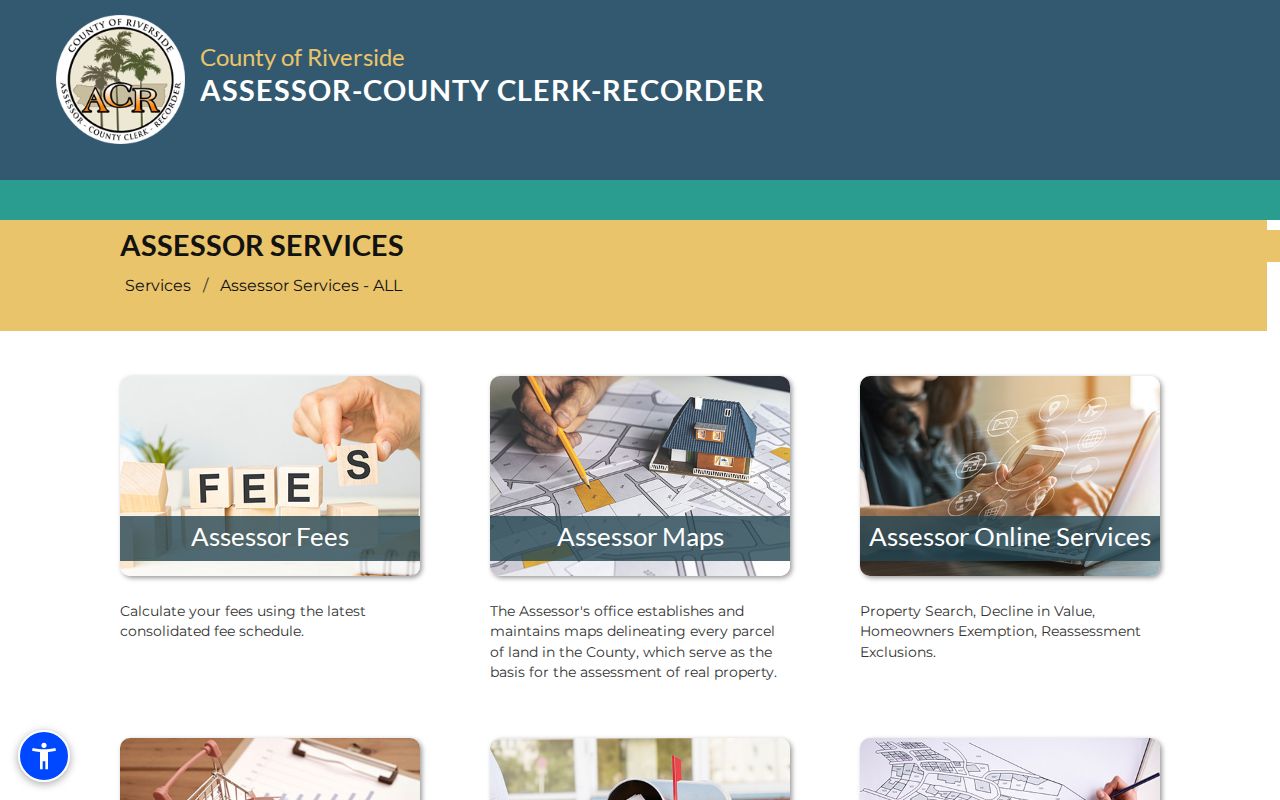
The launch page distinguishes parcel and map work from the office roll, which prevents a web-only search from overstating what the assessor publishes.
The ACR Search Fields That Matter
Riverside ACR’s document index is a party and document system, not a street roster. A name search can use an individual form such as LAST FIRST MI, while an organization is searched as spelled. Date fields narrow the run. Document number search uses a year and sequence format, and map or book-and-page modes handle recorded map references. Advanced name symbols can broaden or limit a term. These fields help a Palm Springs residents directory researcher move from a known person to a known instrument.
| Name | Individual LAST FIRST MI, broader last name and first initial, or an organization name. |
|---|---|
| Recording dates | Start and end dates in mm/dd/yyyy format; useful for a likely purchase or transfer window. |
| Document type | Multi-select control; the captured interface did not expose every option, so verify choices in the live form. |
| Advanced name search | Plus to require, minus to exclude, dollar sign for sounds-like, question mark for one uncertain character, asterisk for starts-with, and tilde for fuzzy or proximity matching. |
| Document number | YYYY-NNNNNN, with the sequence expanding from six to seven digits on December 23, 2003. |
| Book, roll, page, or cert | Map-mode locators for records that use a book or map reference instead of a party name. |
The index is free to search, but an official copy is a separate transaction. Riverside reports an $8 first page, $1 for each added page, and $2 for certification. Online orders are mailed and average 48-hour processing, with a 2.15 percent card fee. In-person requests are commonly same day unless a record is older or extensive. These are copy-channel facts, not proof that a person occupied the property.
The Riverside recording services page is the manifest source for the county’s document-index and copy channels.
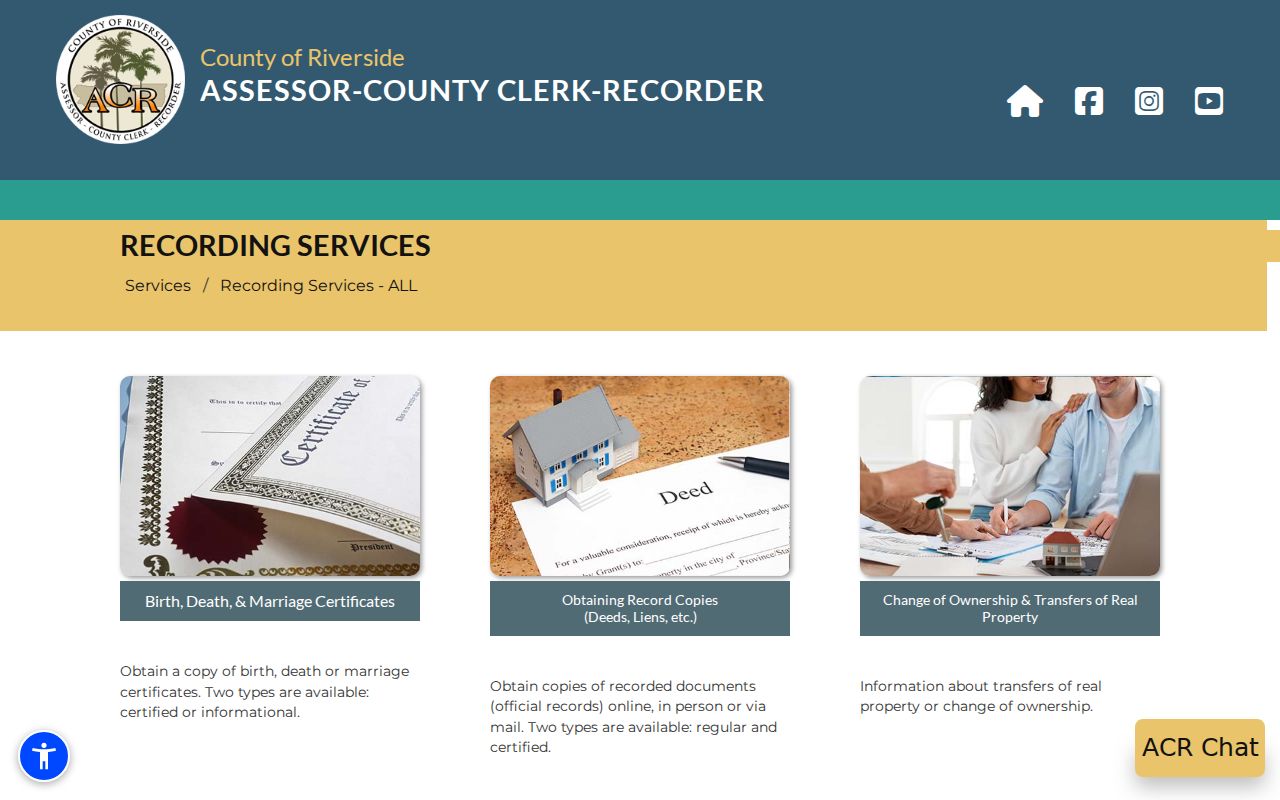
Use a party name to find the instrument, then rely on its recording number and legal description when continuing the chain.
Reading Palm Springs Resident Records
The labels in a Palm Springs residents directory search carry different proof. A roll, an index, a parcel, and a criss-cross directory each point to a different keeper and a different kind of fact.
- Roll
- A maintained list or assessment record, such as the county property or voter record, with its own access rules.
- Index
- A finding aid for recorded documents or court matters; an index result is not always the underlying image.
- Parcel
- A mapped unit of land identified by an APN, situs address, and legal description.
- Criss-cross directory
- A reverse address section that may connect a street address with a listed name in a particular historical volume.
Using the correct term keeps a web parcel result from being described as a household roll and keeps a historical entry from being described as a current record.
Which Current Palm Springs Rolls Answer What
A current Palm Springs residents directory is best treated as a set of narrow sources. The assessment parcel can establish an APN, situs, tax, and property facts. The owner roll is inspected through the assessor under Revenue and Taxation Code section 408 limits. The recorder shows parties to recorded instruments. The court index shows party roles and case events within its coverage. The state voter tool verifies the requester’s own record, not a neighbor list.
| Source | What It Lists | Keeper | Access Boundary |
|---|---|---|---|
| Assessment parcel | APN, situs, assessed and property facts | Riverside ACR | Address/APN web search; owner roll at office |
| Recorded document index | Deed parties, liens, maps, recording numbers | Riverside Recorder | Free index; copies ordered separately |
| Court index | Case number, parties, roles, filing events | Riverside Superior Court | Account and name-search credits; terminal alternative |
| Voter self-status | One voter’s address, status, party, and district | California Secretary of State | Identity-gated self-check |
| City records request | Existing permits, correspondence, or municipal records | Palm Springs NextRequest | Focused CPRA request; exemptions may apply |
That table is also a warning against overclaiming. A matching mailing and situs address supports an owner-occupancy inference but does not prove every person in the household. A business filing gives a contact or officer role at a dated filing, not a home. A directory entry gives historical placement, not a current status. The strongest lookup pairs two non-circular sources and preserves the date. A whole-street question can then continue in the Palm Springs street directory.
Palm Springs Court Names Since 1993
Riverside Superior Court’s Palm Springs Courthouse handles civil, small claims, unlawful-detainer, and probate matters, with public-viewing computers. Remote Palm Springs civil and small-claims coverage begins September 1993. The portal’s Index module searches person or organization names for a fee. A case number opens the Register of Actions and eligible documents. The calendar shows current and future dates up to seven days, while remote access remains limited by California Rules of Court 2.501 and 2.503.
A court-performed record search is a useful fallback when self-search does not fit the task. The Riverside request form charges $15 per name and returns case-number matches rather than copies. The courthouse address is 3255 E. Tahquitz Canyon Way, Palm Springs, and the listed phone is 760-393-2617. Family, juvenile, adoption, sealed, and protected details remain restricted. A calendar entry is not an outcome, and a filing is not a finding.
The Riverside Superior Court public portal is the account-gated route for the index, register, calendar, and eligible documents.
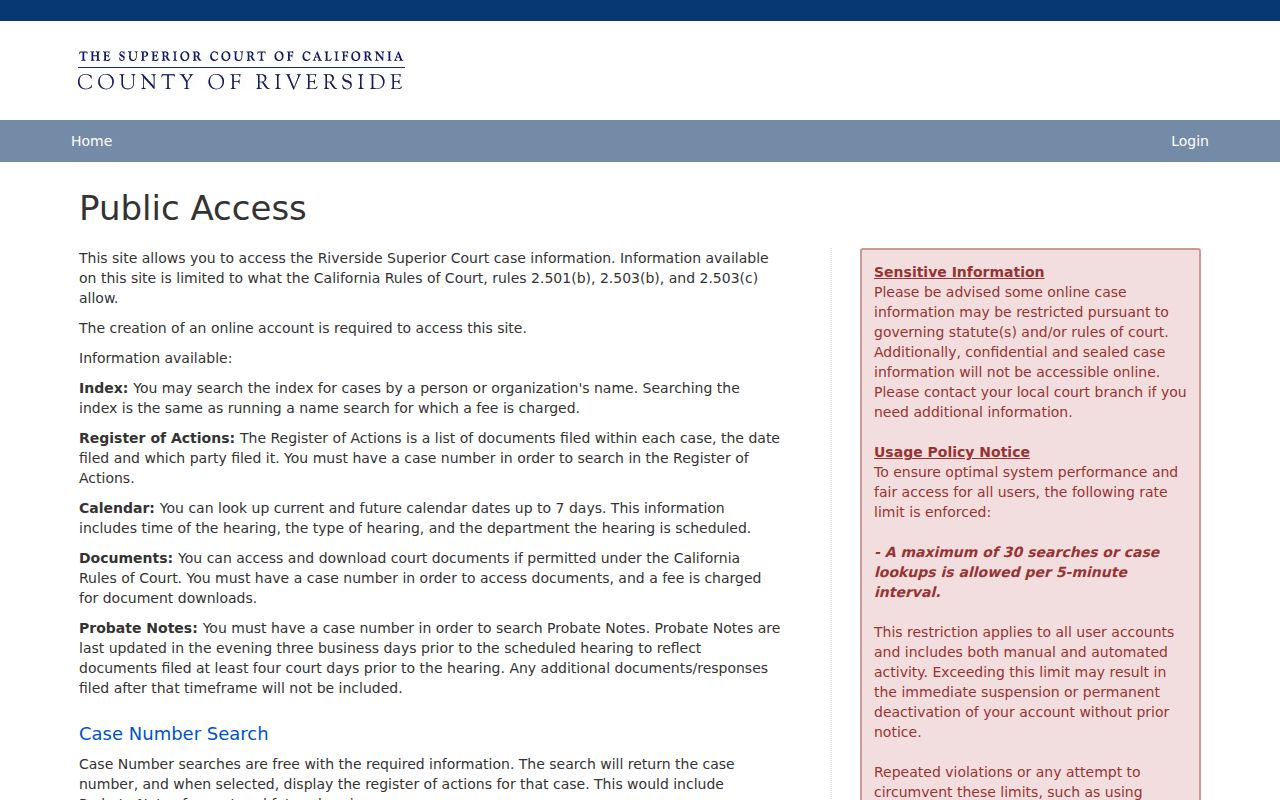
When the remote result omits a document, the free courthouse terminal or clerk copy is the better next channel.
Federal matters do not belong in the county portal. They are searched through the U.S. District Court for the Central District of California using PACER, with its own account and fee rules.
California Voter Status Checks Itself
California My Voter Status is often mistaken for a residents directory, but its design proves the opposite. It asks for first and last name, date of birth, and either a California driver license or ID number or the last four digits of a Social Security number. A match can show the requester’s registration address and status, party preference, language, vote-by-mail or provisional status, polling place, future election details, and county contact. Close the browser after use.
- First and last name
- Required exact registration match.
- Date of birth
- Required month, day, and year selectors for authentication.
- DL or ID / SSN4
- Conditional identity field; the form provides a no-number option.
- Submit
- Returns the authenticated voter’s own status, not a browseable address list.
The California My Voter Status form is the official self-check captured for Palm Springs research.
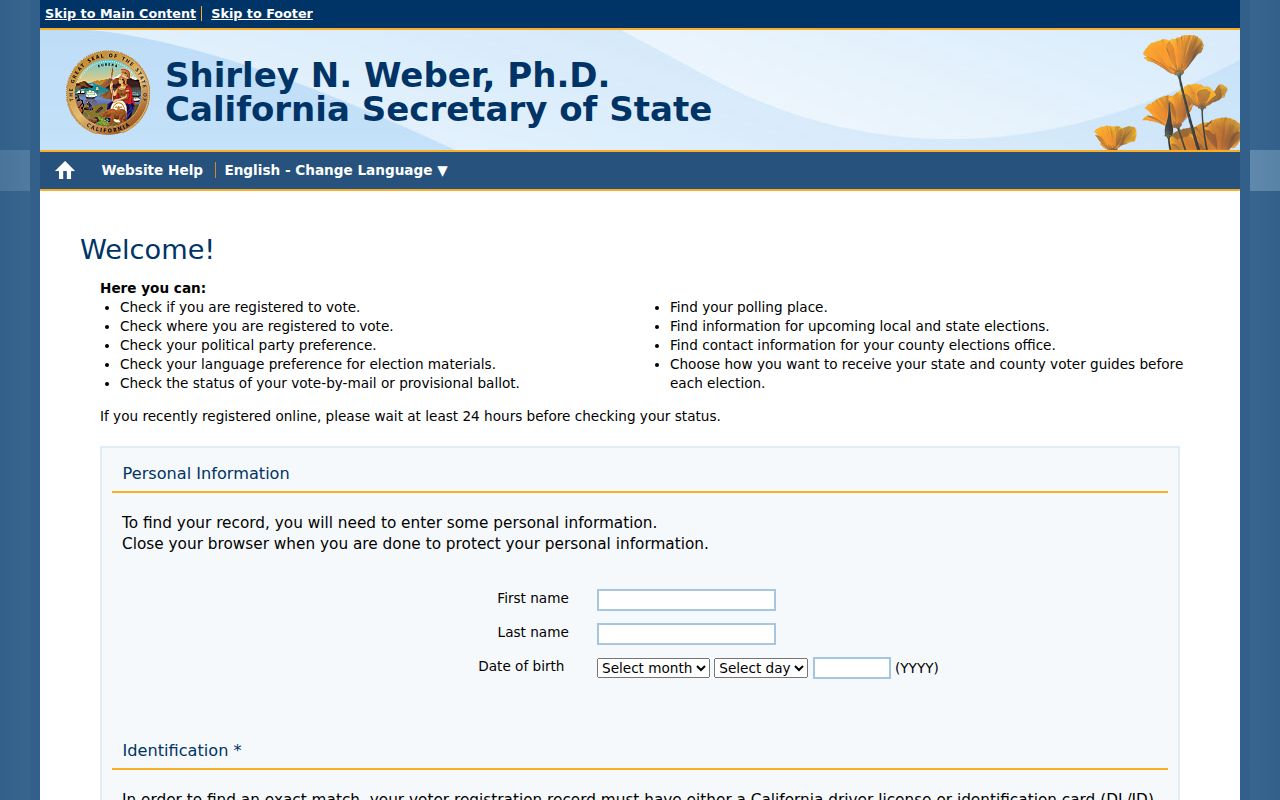
California voter data supplied to qualified requesters remains limited by Elections Code section 2194 and 2 CCR sections 19001 through 19013.
A full voter file is available only for an election, scholarly, journalistic, political, or governmental purpose. The statewide request is $100, while a specific-voter request is $30 per voter up to the stated maximum and requires full identity details, county, residence address, purpose, security acknowledgments, and payment. The Riverside elections FAQs also explain registration maintenance and public-record request routes. A casual Palm Springs neighbor lookup is not an authorized reason to obtain or republish a voter roster.
Vital Records Need the Right Copy
Birth, death, marriage, and divorce records are split by event and custodian. Riverside University Health System Public Health registers current and previous-year births and deaths. Riverside ACR issues county birth and death records for all years and public marriages. Confidential marriages remain with the county clerk. The California Department of Public Health maintains the statewide system, while a divorce decree comes from Superior Court.
California does not use a simple universal rule that ordinary certificates open after a fixed number of years. Informational certified copies of non-confidential birth, death, and public marriage records are generally available to a requester but carry a notice that they cannot establish identity. Authorized copies require an eligible relationship and a notarized sworn statement under Health and Safety Code sections 103525 and 103526. Confidential marriage copies are limited by Family Code section 511. Adoption and original birth records require the statutory or court process.
| Event | Local Keeper | State Route | Key Boundary |
|---|---|---|---|
| Birth or death | RUHS for current or prior year; ACR for county years | CDPH statewide | Informational and authorized copies differ |
| Public marriage | ACR where the license issued | CDPH statewide | Copy type and relationship matter |
| Confidential marriage | County clerk where issued | Not an ordinary public copy | Parties or court order |
| Divorce | Riverside Superior Court decree | CDPH certificate function | Certificate is not the full case file |
Riverside reports birth records may be ordered 21 days after birth and death records after eight days; recorder certificates are commonly available four to six weeks after the event. County ordering offers online, in-person, mail, and drop-box paths. A mail application for an authorized copy needs the sworn statement and notarization. A Palm Springs residents directory result should name the copy type rather than implying that a public index proves a relationship.
Palm Springs Requests in the Numbers
The Palm Springs City Clerk’s records-request system shows what a practical public-records fallback looks like. The FY2025 performance report recorded 1,166 California Public Records Act requests through August 26, 2025, with 1,800 projected for the year. Mean completion was 6.66 days, compared with 6.93 in 2024, 7.43 in 2023, and 13.76 in 2021/22. Those figures describe city workload, not a promise that every request will be filled on the same schedule.
The Palm Springs NextRequest portal is the city channel for a focused public-records request.
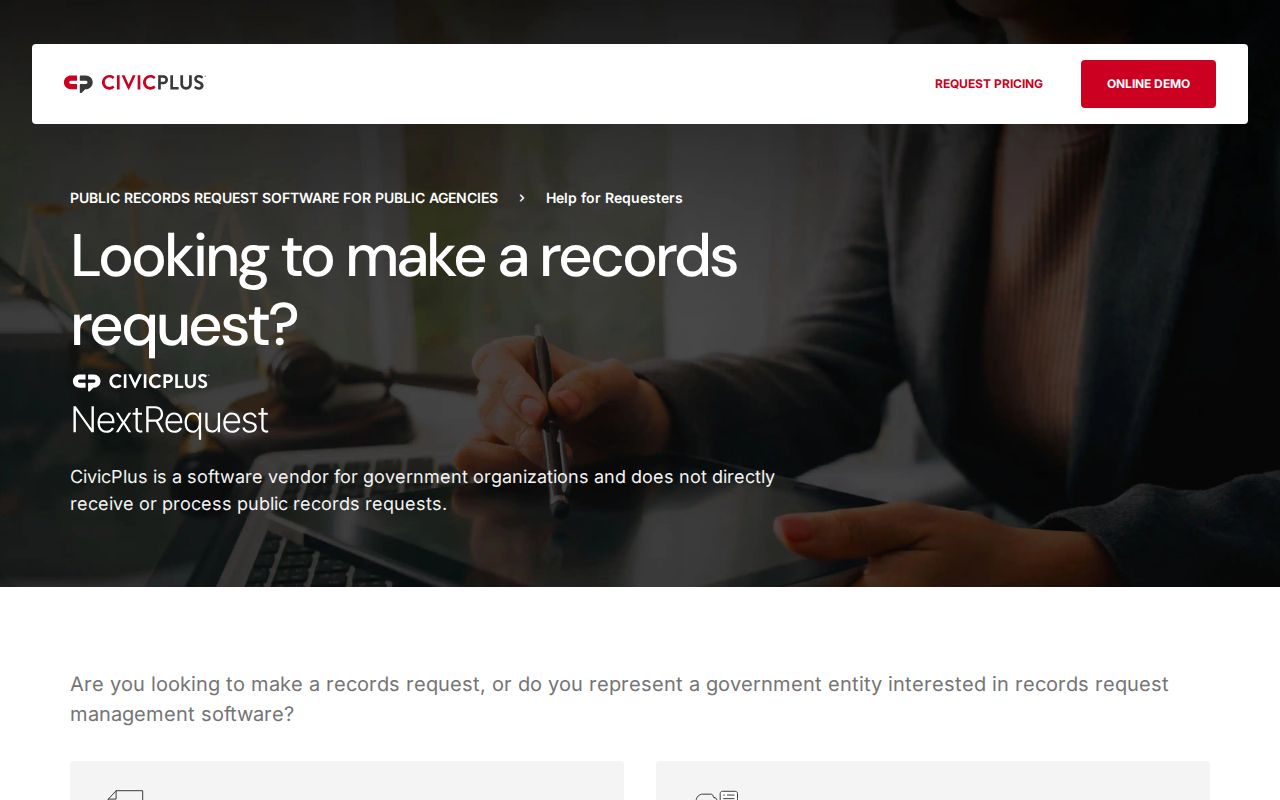
Describe a department, date span, address or APN, permit number, parties, and desired format so the custodian can search an existing record set.
The CPRA is Government Code sections 7920.000 through 7931.000. A written request generally receives an initial determination within 10 days, with a possible 14-day extension in unusual circumstances. That is a determination period, not a guaranteed production date. The city must help identify responsive records but need not create a new list or answer a set of questions. Direct duplication costs may be recovered.
A useful request asks for electronic permit records for a named address or APN, a date range, permit number, issue and final dates, work description, and applicant or contractor fields, while separating plans if they carry a different charge. A request for “everyone who lives here” asks the city to make a new compilation and is poorly matched to the statute.
Palm Springs City Directories Through the Years
Palm Springs city directories are the historical shelf within a Palm Springs residents directory search. The verified local run includes 1938, 1941, 1943 through 1948, 1950 through 1959, and 1961 through 1964. A 1952 volume is cited to Pacific Directory Company. The 1964 “Season Directory - The Yellow Book” was made by Western Directory Co. through a house-to-house canvass and includes alphabetical residents, businesses, civic material, and lodge material. Gaps must remain visible.
Palm Springs Public Library offers Ancestry Library Edition onsite, HeritageQuest, the digitized Desert Sun from 1934 through 1993, Palm Springs High School yearbooks, phone directories through Accessing the Past, interlibrary loan, and librarian research help. The library lists 760-322-7323 and a one-to-two-business-day email response. The Historical Society Research Center at Welwood Murray, 100 S Palm Canyon, holds photographs, books, periodicals, manuscripts, and maps by appointment.
For a deeper household trail, use the dedicated Palm Springs city directory page, which keeps collection years and reading rules together. A directory can place a person at an address on a publication date, but a missed name may reflect seasonal residence, canvass omission, a directory gap, a changed abbreviation, or the documented displacement of households in Palm Springs history.
Business Records Are Not Residence Proof
When a name is tied to a local business, California Secretary of State bizfile, Riverside fictitious business name filings, Palm Springs business-license material, and professional-license systems can add a dated public role. Bizfile searches corporations, LLCs, limited partnerships, and nonprofits by name or file number. A result can show entity status, formation date, agent for service, principal or mailing address, Statement of Information fields, and filing images. A business address remains a business fact.
The California bizfile search is the official entity route for a Palm Springs business-name trail.
Preserve the entity number and filing date before comparing a person name with another record.
The California Department of Consumer Affairs search adds board, license type, name, number, city, or county paths. The county FBN route is important for a sole proprietor whose name does not appear as an entity. Palm Springs business-license material lists an online application and renewal path, with residential addresses protected in some circumstances under AB 2184. These sources help confirm a public professional or commercial connection, not a household.
Comparison. An official custodian supplies a defined record, date, access rule, and correction path. A commercial compiled-data category may combine public and licensed sources, charge recurring fees, merge same-name people, or retain stale addresses. It is a lead, not a replacement for the custodian.
When Palm Springs Records Reach 1893
Riverside County formed on May 9, 1893 from parts of San Bernardino and San Diego counties. Palm Springs incorporated on April 18, 1938. A Palm Springs residents directory search for an earlier person or parcel may therefore need predecessor county descriptions, tribal or federal material, community sources, and private collections rather than a city file. The city’s documented government actions from 1936-37 and 1948-66 also warn that directories can omit households displaced through public programs.
California State Archives records can supplement local indexes for historic state-government, naturalization, legislative, and selected county material. The Prickly Pear Collection preserves recorded interviews with residents, including Cahuilla elders. The Historical Society and library add the human and neighborhood context that a deed index cannot supply. Keep those layers distinct: a story, directory, census entry, and deed may all concern one address while proving different facts.
The California Department of Consumer Affairs search illustrates why a statewide custodian can complement a county resident trail.
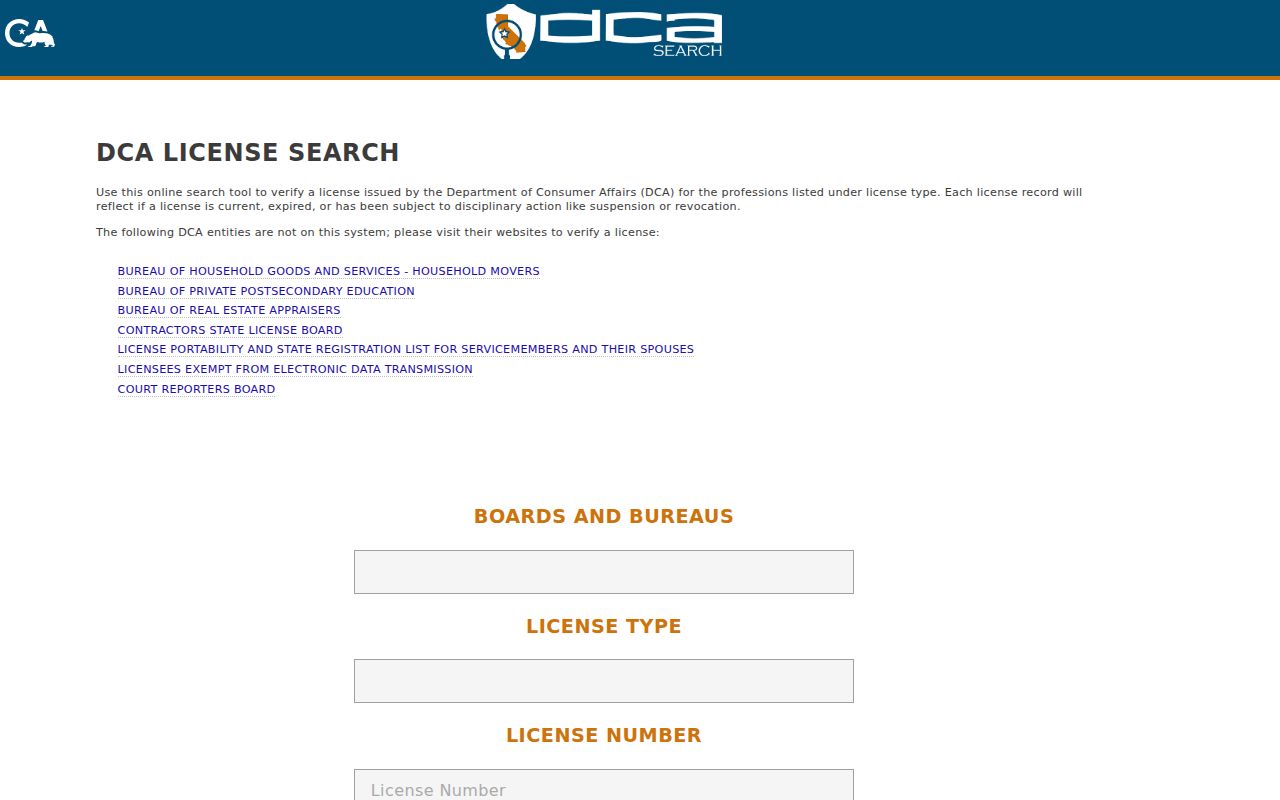
Statewide indexes can confirm a public license role, but they should not be merged with residence evidence without a second, dated source.
Safe at Home Changes Palm Springs Visibility
California’s Safe at Home program changes what a public search may reveal for qualifying survivors and threatened public or health workers. It supplies a substitute mailing address, forwards mail, supports confidential voter registration, provides a confidential name-change process, and enables DMV suppression for qualifying participants. Government Code sections 6205 and following govern the program, and section 6209.5 permits substitution in some deeds and change-of-ownership records while a legal description may still identify land.
California’s voter rules also withhold driver-license and Social Security fragments, signatures, unique identifiers, confidential voters, protected voters, and preregistration data. Since January 1, 2026, the state’s DROP process lets a California resident make one data-broker deletion request; broker batching began August 1, 2026. The California Privacy Protection Agency and Secretary of State are the better places to verify current rules. A missing name is not proof that no person exists.
Lawful personal use. Palm Springs public records support family history, property research, civic questions, and safe reconnection. Do not use a lookup to stalk, harass, intimidate, or harm anyone, and verify a material claim with the office that holds the record.