
Sources for Palm Springs Previous Residents
A past-resident question needs an era plan. Riverside’s recorder index is online for recorder documents from January 1, 1974 forward, while older recorder research moves to Gateway Riverside. Palm Springs city directories are verified for selected years from 1938 through 1964. Phone books reach from 1950 into 1961. The federal census is released through 1950 as of 2026. City permits, Sanborn maps, Desert Sun notices, probate, and Historical Society material fill other kinds of gaps.
| Source | Years It Covers | Where Held | What It Shows |
|---|---|---|---|
| Recorder index | 1974-present online; earlier at Gateway | Riverside ACR | Recorded parties, instruments, dates, legal descriptions |
| Palm Springs city directories | 1938, 1941, 1943-48, 1950-59, 1961-64 | Library and Accessing the Past | Dated names, addresses, and local context |
| Telephone directories | 1950-1961 verified runs | Library of Congress and library | Name, residence mark, address, telephone |
| Federal census | Through 1950 released as of 2026 | NARA and library databases | Enumerated households on a census date |
| Permits and tract maps | Dates vary | Palm Springs City Clerk | Construction and change chronology |
| Sanborn maps | 1929 and 1962 documented | LOC, library, city studies | Footprint, structure, and use context |
Start with the source that matches the question. Title belongs to the recorder. A resident name at a date belongs to a directory, census, newspaper, or other contemporaneous record. A map can show a structure without naming the household.
Start With Today’s Palm Springs APN
The current situs address is the bridge into a Palm Springs previous residents search. Riverside ACR property tools can turn a street number and name into an APN and parcel facts. Map My County can show geometry, tract, lot, historic, ZIP, district, and reservation overlays. The public web parcel result does not display owner names, so an owner roll may require assessor-office inspection under Revenue and Taxation Code section 408.
Keep the physical situs, owner mailing address, APN, and legal description in separate fields. A different mailing address can suggest that the owner was not the occupant, but it does not prove who lived there. The APN and legal description are the better keys when the street label shifts or an older instrument uses a tract and lot.
Once the current parcel is anchored, the current deed can be found by searching the known owner or instrument. That is the handoff from a modern address to a backward record chain.
Crossing Riverside’s 1974 Recorder Boundary
Riverside recorder documents are indexed online from January 1, 1974. Pre-1974 recorder research must move to Gateway Riverside. Clerk documents reach back to January 1, 1893, but clerk and recorder indexes are different. The county’s public computers cover about 1975 forward, and the Palm Desert counter is a regular desert access point for current requests. An online dead end at 1974 is therefore an access boundary, not evidence that the house had no earlier record.
Online copy ordering, in-person requests, mail, and phone guidance are separate channels. The county reports an $8 first page, $1 for each additional page, and $2 for certification. Mail research for a pre-1976 estimated date is limited to two years after the estimate, so a known party, date, document type, and APN make the request stronger.
The Riverside record-copy instructions explain the official copy route and the older-record cutoff.
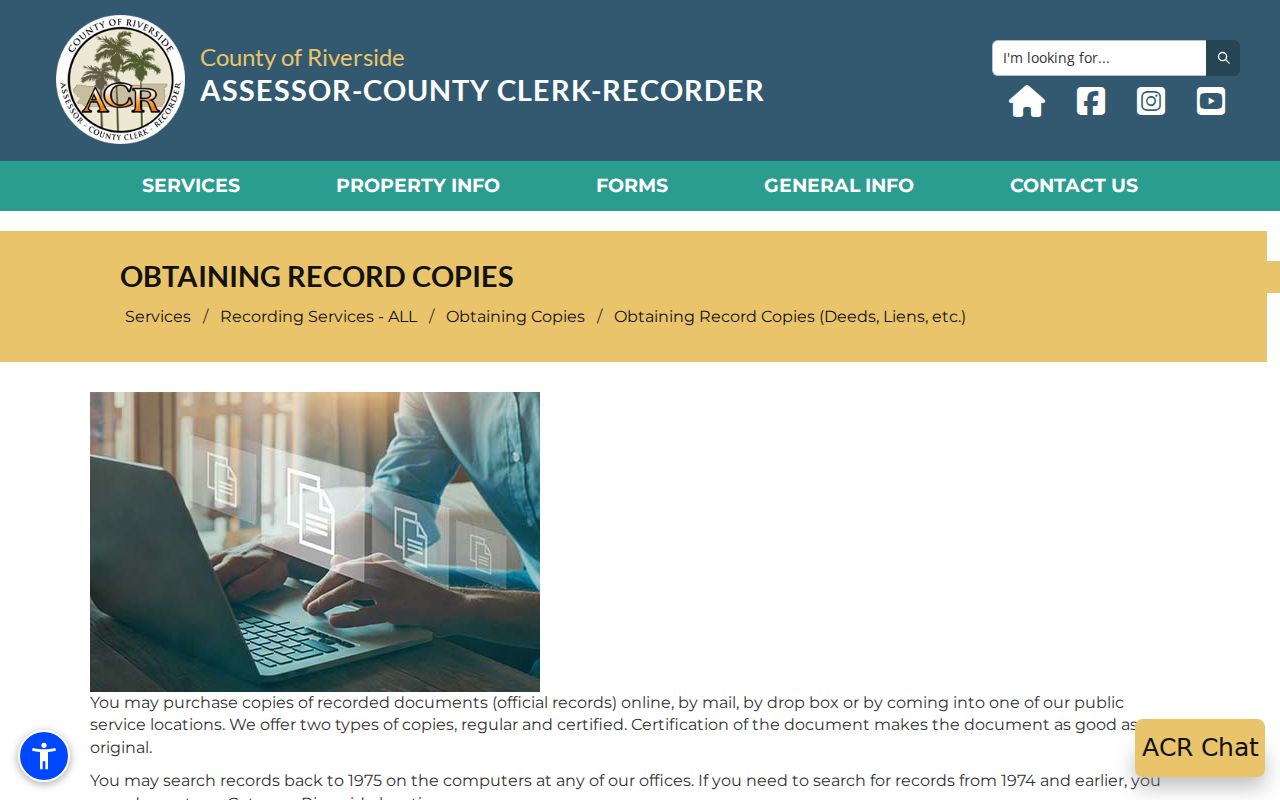
Use a statutory copy channel for the instrument itself, and use library or map sources to develop the party and date before requesting it.
Tracing Palm Springs Past Owners Through Deeds
A deed chain walks backward from today’s recorded owner. The recorder’s index is party based, so an address alone is not a sufficient search key. Begin with the APN and legal description, identify the current acquisition instrument, then pivot from the seller or grantor to the earlier grantee. Repeat until the online index ends or the legal description changes.
- Normalize the current situs address in ACR property tools and save the APN and legal description.
- Obtain the permitted current ownership information at an assessor office, keeping the mailing address separate from the situs.
- Search the owner in the recorder’s Name Search, narrow the date and document type, and identify the acquisition deed.
- Record grantee, grantor, recording date, document number, and legal description, then search the seller as an earlier grantee.
- Repeat the party pivot and move to Gateway Riverside when the chain reaches pre-1974 records.
- Overlay permits, directories, census, Sanborn maps, newspapers, obituaries, and probate without treating any one layer as title.
- Grantor
- The party transferring or conveying an interest in the recorded instrument.
- Grantee
- The party receiving the recorded interest.
- Chain of title
- The linked sequence of recorded transfers used to trace an interest through earlier parties.
- Legal description
- The formal land description that can identify a parcel when a street address is changed or incomplete.
The chain shows recorded ownership instruments. It does not prove a move-in date, daily occupancy, or every household member.
Seller to Earlier Grantee in Riverside Records
The grantor-to-grantee pivot is the practical heart of a Palm Springs previous residents search. A current deed names the seller and buyer, but the seller may be an estate, trust, company, or representative. Search the party exactly as printed, use the legal description to rule out a same-name hit, and preserve the recording number. If the chain splits or a parcel changes, note the break rather than forcing a straight line.
Older instruments may need a counter search, book, map, or library clue. The ACR document interface includes Name Search, Document Number, Document Type, Map Type, Book/Page, and Advanced Search. Its inspected name controls support plus, minus, sounds-like, uncertain-character, starts-with, and fuzzy or proximity symbols. The document-type list was not fully exposed in the unattended inspection, so live choices should be checked before a narrow claim is made.
A paid copy is useful when a legal description, party role, or map reference must be read. Keep the index result and the copy together. They are two views of one instrument, not two independent confirmations.
Palm Springs House History: Permits and Maps
Palm Springs City Clerk research can connect a current address to permit history and old tract maps. The city’s property-research handout points researchers to a City Clerk public-records request, the Palm Springs Historical Society’s photo archive and old phone books, the library, Desert Sun, and Sanborn maps. Palm Springs Online groups current applications and inspections, but the research did not expose a complete public search-field inventory, so an exact street-wide browse should not be promised.
A focused request should name the address or APN, the date span, permit number if known, desired fields, and format. Permit dates can show construction or alteration chronology. An applicant may be an owner, contractor, or agent at the time. A plan or permit cannot by itself establish who lived in the structure.
The useful local sequence is APN and tract map, permit request, Historical Society photographs or phone books, Desert Sun search, then a Sanborn comparison. Each step adds a different kind of context to the previous residents trail.
Past Palm Springs Households in Directory Years
Ownership is only half of the previous residents question. Palm Springs city directories are verified for selected years between 1938 and 1964. Regional telephone directories cover 1950 through 1961. A local entry can show a printed name, residence mark, house number, street abbreviation, locality, and telephone number. The 1964 Yellow Book records a house-to-house canvass but also warns of errors and omissions.
Pair a directory year with the nearest released census. The 1950 census is the latest released as of 2026 under the 72-year rule. Allow for publication lag and different address forms. A person may be listed in the directory before the census or be missed by one source. The correct conclusion is limited to the checked edition and date.
- Copy the exact address and name from the directory or telephone page.
- Check the closest released census and record the household as enumerated on its date.
- Compare the next available directory edition for a move, changed initial, or disappearance.
- Search the Desert Sun for obituary, social, legal, or address context.
- Use the City Directory collections themselves through the Palm Springs city directory archive when the year or reading key needs confirmation.
Seasonal residence, canvass omission, publication gaps, OCR failure, and name change remain possible explanations when a household vanishes.
1929 and 1962 Sanborn Clues
Sanborn maps documented for Palm Springs in 1929 and 1962 can show a structure’s footprint, use, and physical change. They are not occupant proof. A map can tell a house historian that the building existed in a form at a date, then point toward a permit, directory, census, or newspaper source for people.
The Library of Congress Sanborn collection supplies context and digital access. Compare the map sheet with tract names, APN, a city historic-resource entry, and a directory address. The checkerboard reservation geography may require an additional tribal or federal land-status path when a parcel crosses those regimes.
A previous residents account is more credible when it states exactly what the map proves and what it cannot. Footprint, use, ownership, and occupancy are different records questions.
Probate, Obituaries, and Previous Residents
Obituaries and probate can close a historical trail when a person died at or after leaving an address. Desert Sun material from 1934 through 1993 can supply an obituary, social notice, legal notice, or family clue. Probate petitions and notices can name heirs and property interests, but Superior Court access rules, sealed details, and document-copy procedures still apply.
Use an obituary as a lead to a death record, probate file, deed, or cemetery source. Use a probate name as a lead to the recorder’s legal description. Do not treat an obituary address as title, or a probate reference as proof of where every heir lived. The source and date must remain visible.
The Historical Society Research Center, at Welwood Murray Memorial Library, 100 S Palm Canyon, holds photos, books, periodicals, manuscripts, and maps by appointment. Its archive can add a human context to a name that otherwise appears only as a party in a deed.
Palm Springs Records Before 1893
Riverside County was created in 1893 from San Bernardino and San Diego territory. A Palm Springs house history that reaches earlier may be cataloged under those predecessor counties rather than Riverside. Palm Springs incorporated in 1938, so earlier municipal evidence may be county, tribal, federal, community, or private. The California State Archives can supplement the local recorder for selected state-government, naturalization, legislative, and county material.
The California State Archives is the state-level route for older government records that may sit outside a local Palm Springs index.
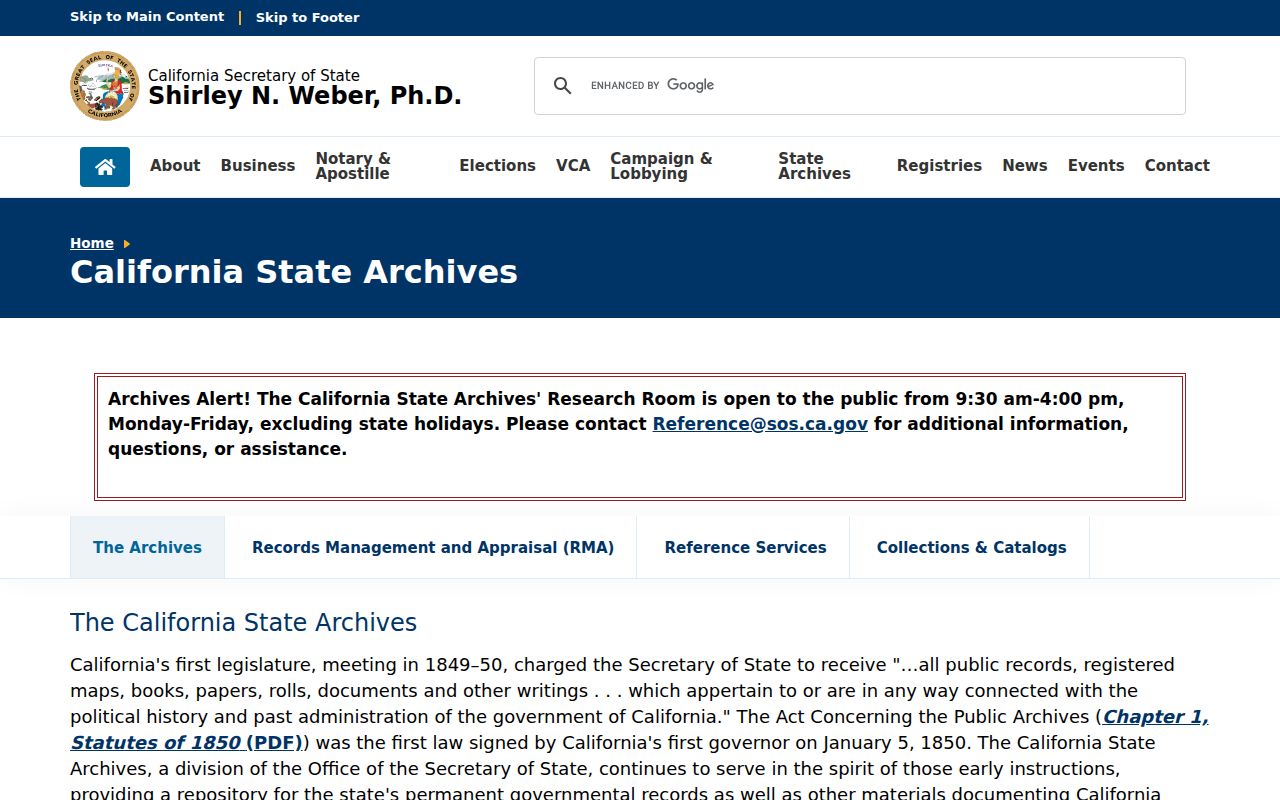
Predecessor-county descriptions and state catalog terms can keep an early address search from stopping at the Riverside boundary.
A missing early deed or directory is not evidence that a place had no earlier residents. It may mean the record belongs to another jurisdiction or collection.
Previous Residents Need a Careful Close
Previous residents are best reported as a dated chain: recorded owner in an instrument, named occupant in a directory or census, structure clue on a Sanborn map, and family or estate clue in a newspaper or probate file. Each source has a different keeper and access boundary. The full current street chain belongs with the Palm Springs street directory, while the historical collections belong with the library archive.
The Historical Society Research Center page is the manifest source for this local-archive view.
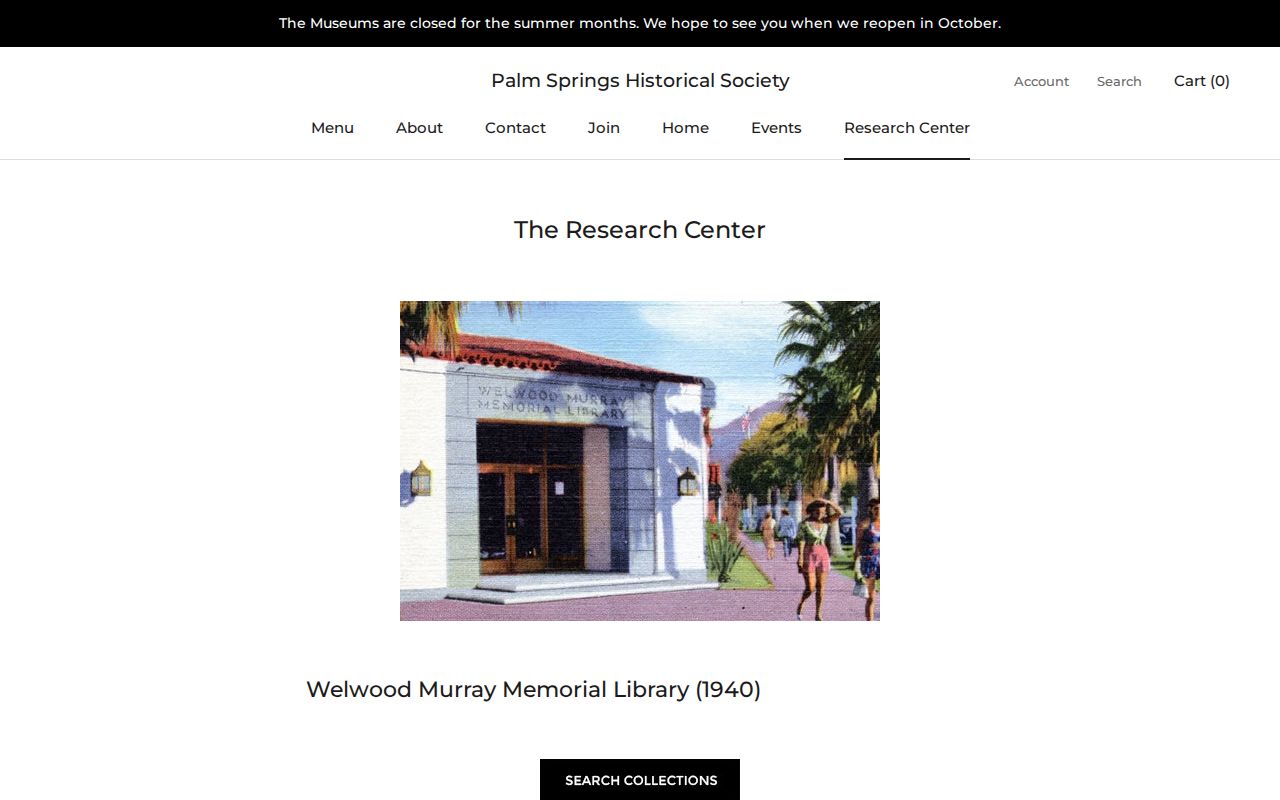
Archive context can explain a household trail without converting a private collection into a public current roster.
Lawful house history. Palm Springs past-resident research is for family history, property history, estate questions, and personal curiosity. Do not use it to stalk, harass, track, or intimidate a living person.
Write “not found in this checked edition” when the evidence stops. That simple phrase preserves the difference between an incomplete record and a claim about a person.