
Palm Springs Resident Lookup Evidence Matrix
A Palm Springs resident lookup should begin with the record type that can actually answer the question. The Riverside assessor can connect an address to a parcel and maintain an office ownership roll. The recorder indexes parties to recorded instruments. The court index supplies cases and filing events. Vital custodians control copies and relationship rules. A business or license file shows a dated public role. A directory or newspaper can place a person in an earlier period.
| Record | What It Confirms | Where to Search | Access |
|---|---|---|---|
| Assessment parcel | APN, situs, property facts, office ownership roll | Riverside ACR | Web address/APN; owner roll at office |
| Recorded deed or lien | Party names, roles, legal description, recording date | Riverside Recorder | Free index; copies ordered |
| Court index | Case number, party role, type, filing events, possible disposition clues | Riverside Superior Court | Account and name-search credits; terminal |
| Vital record | Birth, death, marriage, or divorce event and relationship limits | Riverside ACR or CDPH | Copy type and eligibility control access |
| Business or license file | Entity, agent, officer, license status, public contact role | SOS, FBN, DCA | Public business or professional facts |
| Directory or newspaper | Dated address, phone, social, school, or obituary lead | Palm Springs Library and archives | Historical and error-prone |
The matrix keeps current residence, property ownership, public role, and historical placement from collapsing into one label. Start with the narrowest record. Then require a second, non-circular point before deciding that two records refer to the same person.
Riverside Court Fields for a Resident Lookup
Riverside Superior Court’s public portal separates a person-name Index from a case-number Register of Actions and Documents. The court’s public-access guidance confirms the access split. Palm Springs civil and small-claims coverage begins September 1993. The Palm Springs Courthouse at 3255 E. Tahquitz Canyon Way has public-viewing computers, while the remote portal requires an account and charges for name-search credits. A court-performed search through the Riverside request form costs $15 per name and returns case-number matches.
| Case type | Civil, Family Law, Probate, Criminal, or Traffic on the court request form. |
|---|---|
| Case number | Optional for a request; required to open the Register of Actions and document modules. |
| Filed between | Date pair used to narrow the court search. |
| Additional information | Courthouse, parties, aliases, and the information sought. |
| Delivery details | First and last name, email, phone, and alternate phone fields. |
| Payment | The form proceeds to the $15 search payment; copies and certification are separate. |
The calendar exposes date, case number, caption, hearing time, and department in the rolling Palm Springs PDF. A docket adds case type, parties and filing events. A calendar appearance is not proof of outcome. Juvenile, adoption, sealed, confidential, and protected family details may be omitted.
The Palm Springs Same-Name Check
Same-name errors are the central risk in a Palm Springs resident lookup. Write the indexed form, initials, dates, APN or legal description, business or case number, and associated parties before merging records. Require two independent links, such as a middle initial plus the same legal description, or a directory address plus a matching census household. Two sites that repeat the same county index are one source, not two.
Do not merge people because a surname, age, neighborhood, or mailing city looks close. A deed’s recording date can follow execution. A directory’s canvass can precede publication. A court filing address can be a service address. A business agent can be a professional representative. Each fact needs the custodian and date kept beside it.
- Docket
- The court’s running record of filings, dates, parties, and case events.
- Index versus image
- An index is a finding aid; an image or certified copy is the underlying record when access is allowed.
- Certified copy
- A copy issued or authenticated by the custodian, with status that an ordinary web result does not carry.
- APN
- The assessor’s parcel number that can separate two people with similar names.
Clerks can explain a search channel and locate a known number. They generally cannot certify by phone that two same-name people are identical.
Verifying a Palm Springs Resident’s Records
Verification works from an anchor outward. An address can lead to an APN, the APN can lead to a recorded acquisition deed, and the deed party can be compared with court, business, license, or directory evidence. A name-only hit needs stronger control. Use the source that holds the fact and do not ask a downstream index to correct the original.
- Anchor the name to a known address, business, family connection, or dated record without assuming that the clue proves residence.
- Search the Riverside court Index for the exact name and reasonable variants, then save case number, type, party role, and dates.
- Compare the result with a property, recorder, business, license, directory, or newspaper source that is not copying the same index.
- Order a certified or informational copy from the correct custodian if the event or relationship matters.
- Write the conclusion with the scope, date, and unresolved alternatives, including a possible name change or seasonal listing.
A successful resident lookup often ends with a qualified statement: “the sources place this name at this address in this period.” That is stronger and more honest than a claim of present identity.
Birth, Death, and Marriage Copy Choices
Riverside University Health System Public Health handles current and previous-year births and deaths. Riverside ACR issues county birth and death records for all years and public marriages. Confidential marriages are controlled by the county clerk. CDPH maintains statewide birth, death, fetal death, marriage, and divorce records. Divorce decrees come from Superior Court, not from a general county vital index.
Informational certified copies of non-confidential birth, death, and public marriage records are generally obtainable by any requester but are marked not valid to establish identity. Authorized copies require a qualifying relationship and a notarized sworn statement under Health and Safety Code sections 103525 and 103526. Family Code section 511 limits confidential marriage copies. Adoption and original birth records remain sealed unless the statutory or court process applies.
| Event | Custodian | 2026 Fee in Research | Access Note |
|---|---|---|---|
| Birth | RUHS, ACR, or CDPH | ACR $34; CDPH $31 | Informational versus authorized copy |
| Death | RUHS, ACR, or CDPH | ACR/CDPH $26 | Redactions and eligibility may apply |
| Public marriage | ACR where license issued or CDPH | $19 | Copy type and relationship matter |
| Divorce | Riverside Superior Court and CDPH certificate function | CDPH $18 plus court copy fees | Certificate is not the full decree |
The Riverside ACR vital-records copy page is the manifest source for the Palm Springs resident lookup’s birth, death, and marriage channels.
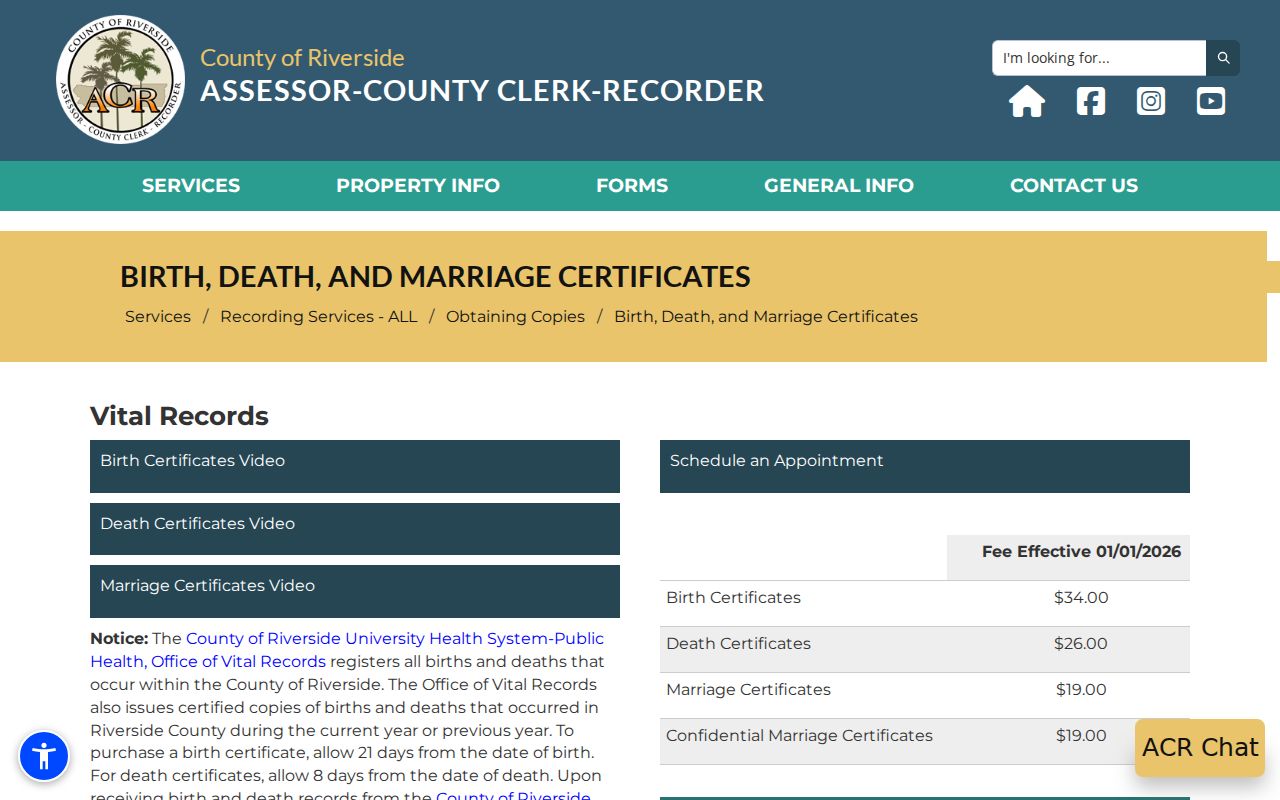
Match the event, custodian, copy type, and eligibility before treating a vital-record result as evidence about a person.
County channels include online, appointment or in-person, mail, and drop box. Mail requests for authorized copies need notarization and the proper check or money order. The CDPH vital-records hub, state fee page, and authorized-copy guidance explain the statewide route. The county registrar and recorder roles page helps identify the right local keeper. CDPH’s direct channel moved to mail on July 1, 2026. A Palm Springs resident lookup should name the record type and copy status rather than presenting a vital lead as an unrestricted name index.
California Voter Status Is a Self-Check
California My Voter Status asks for first name, last name, date of birth, and a driver license or ID number or SSN4. It can return the requester’s address and registration status, party preference, language, vote-by-mail or provisional status, polling place, future election information, and county contact. It cannot be used to browse a Palm Springs street or another person’s household.
The full voter file is limited by Elections Code section 2194 and 2 CCR sections 19001 through 19013. Qualified requesters may use it for election, scholarly, journalistic, political, or governmental purposes. A statewide request costs $100; a specific-voter request can name up to ten people and charges $30 each, subject to the stated maximum. The form requires identity, purpose, geography or fields, security promises, signature, and payment.
Confidential voters, protected participants, preregistration records, driver-license and Social Security fields, signatures, and unique identifiers are excluded. Riverside Registrar of Voters can answer status questions and receive a public-records request, but a casual resident lookup is not a permitted purpose for a published voter roster.
Palm Springs Heirs and Former Classmates
Different personal questions call for different trails. Heirs may appear in probate petitions, notices, deeds, and obituaries, subject to sealing and access rules. Former classmates may surface in Palm Springs High School yearbooks, Desert Sun notices, the library’s databases, and the Historical Society. A possible birth-parent search must use California’s official adoption-information and court process rather than trying to defeat sealed records.
For a deceased person, a newspaper obituary can lead to a death record, probate file, cemetery clue, or family notice. For a living person, a historical directory can establish a past address without proving a current one. In both cases, preserve the exact printed name and the date that supports the connection.
The Palm Springs city directory collection page keeps the year runs, phone books, census pairing, and archive access in one historical shelf. It is a better route than treating a current name search as a substitute for local history.
California License and Business Trails
California Secretary of State bizfile searches corporations, LLCs, limited partnerships, and nonprofits by name or file number. Results can show entity name and number, formation date, status, jurisdiction, agent for service, principal or mailing address, Statement due date, and filing images. Riverside fictitious business name filings help with sole proprietors. Palm Springs business-license material supplies a city authorization trail. DCA and independent boards add license status, city or county, public discipline where supplied, and a license number.
A business or license record confirms a public role at a filing date. It does not automatically establish a home address or current Palm Springs residence. Compare entity numbers, license numbers, middle names, and dated addresses before treating two records as one person. The State Controller’s ClaimIt search can show an unclaimed-property name lead, but a claim requires proof of identity and entitlement and the result is historic by nature. For a statutory public-safety registry, use California Megan’s Law or the CDCR incarcerated-person locator only for the limited record each system describes.
When a Palm Springs Lookup Stalls
An official dead end is a routing problem, not permission to fill a gap with an unverified name list. Visit a free court terminal when the remote portal omits a document. Use the $15 Riverside court-performed search when a known name needs a clerk search. Move pre-1974 deed research to Gateway Riverside. Ask the library or Historical Society for a collection or archive appointment. Send a focused CPRA request for an existing, nonexempt city record rather than asking an agency to create a new resident list.
Correct errors with the custodian that created the record. A directory, commercial data product, or copied index cannot amend a deed, court entry, voter record, or vital certificate. Keep a search date, the exact form used, and the negative scope statement. “No online owner name,” “self-status only,” “copy eligibility not met,” and “volume gap” are meaningful results.
Legal Limits on Palm Springs Lookups
California privacy rules protect confidential voters and Safe at Home participants, restrict DMV data under 18 U.S.C. sections 2721 through 2725, and limit access to juvenile, adoption, sealed, and many family records. The California Privacy Protection Agency’s CCPA and CPRA guidance explains consumer rights for covered business-held data. The DROP program supplies a single deletion path for active registered data brokers, with exceptions and status rules that should be checked at the official portal.
Lawful personal use. A Palm Springs resident lookup is appropriate for family history, reconnecting, estate research, civic questions, and safe personal planning. Do not use records to stalk, harass, intimidate, or harm anyone. Verify a material claim with the custodian before relying on it.
Public does not mean limitless. A missing record may reflect confidentiality, a coverage boundary, a directory omission, or a different keeper. The responsible close to a lookup names what the evidence supports and what it cannot show.