
Finding Palm Springs Streets by Address
A Palm Springs street directory search works best as a short chain. Start with the full situs address. Riverside ACR’s property tools can return an APN and parcel facts, while Map My County supplies the spatial view. The assessor’s public ownership roll is an office channel because owner names are not displayed online. The recorder is then searched by the known party or document, not by a street-wide address field. Historical directories and telephone books can add occupants, but only for the editions and address forms they actually contain.
Follow the chain in order and record the date at each step. The goal is not to publish a block roster. It is to identify which record can answer a property or family-history question without turning an inference into a fact.
- Normalize the street number and name, then run the address through the Riverside ACR property tools.
- Save the APN, legal description, and visible parcel facts, then open the same location in Map My County.
- Inspect the public ownership roll at an ACR office when the owner name is necessary; keep the situs address separate from the mailing address.
- Search the recorder’s index for the owner or acquisition deed, then use the grantor and legal description to continue backward.
- Check the California voter self-status tool only for the requester’s own record, and use historical directories for dated occupant evidence.
The final step changes with the question. A modern parcel question may end at the assessor or recorder. A former household question needs the library, newspapers, census, or Historical Society. If the goal shifts from a street to one person, the Palm Springs resident lookup workflow uses a different confirmation matrix.
Riverside ACR Fields for Palm Springs Addresses
The county property search is address and APN oriented. The county FAQ says an APN can be found by entering only a street number and street name, such as “1234 Main.” The public web result should be described as address, APN, property, and tax information unless a particular field is visually confirmed. Owner names are not displayed online. An assessor office roll may be inspected under Revenue and Taxation Code section 408, but a web user should not claim that a public owner-name search exists.
| Street number and name | Enter the situs address in the county’s address-to-APN path. |
|---|---|
| APN | Use the parcel number to connect the map, assessment facts, permits, and legal description. |
| Situs address | The physical location of the parcel, which can differ from the owner’s mailing address. |
| Ownership roll | Office inspection channel; the web result does not publish owner names. |
| Property facts | Transcribe value, transfer, characteristic, tax, or permit fields only after opening the specific parcel. |
That limitation is central to the Palm Springs street directory. A matching mailing and situs address may support owner occupancy, but it does not prove every resident. An owner can receive mail at a different place, and a mailing address is not a household roster.
The Riverside ACR property search is the exact address and APN route captured in the research.
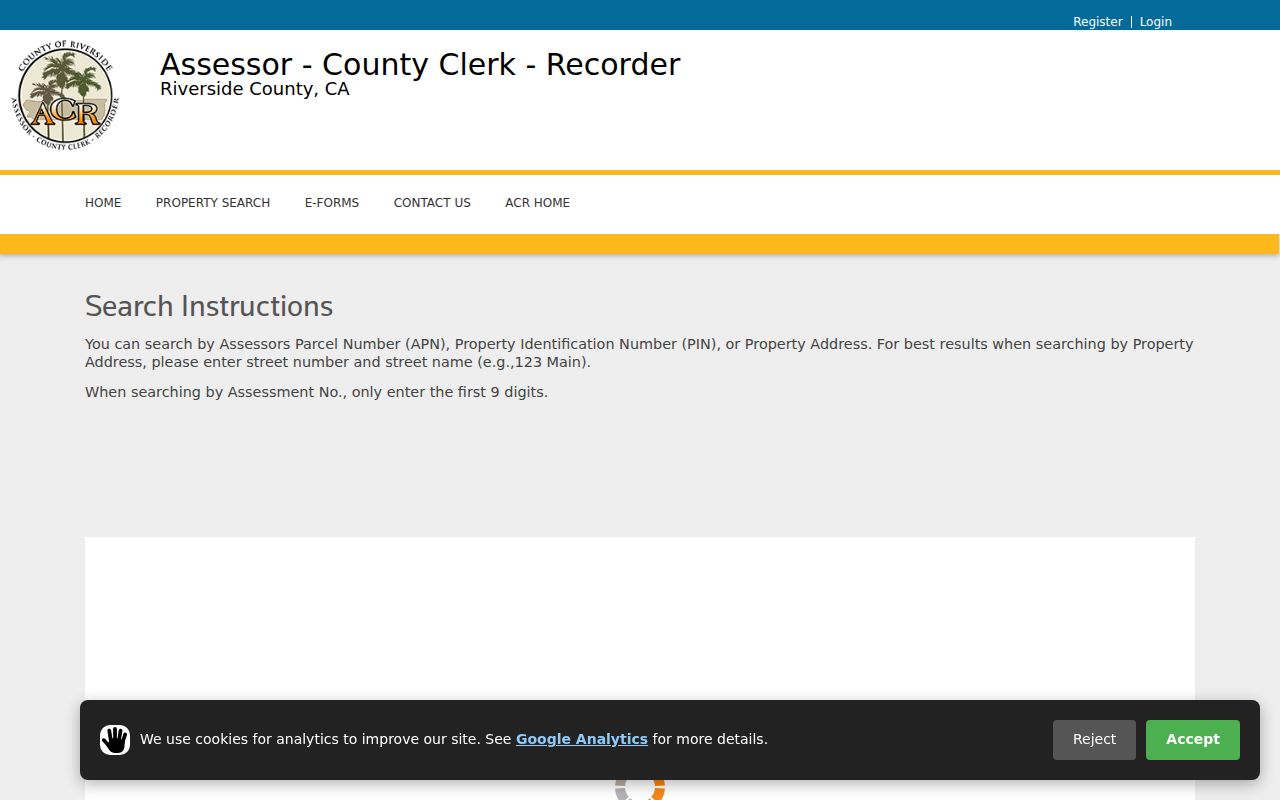
Use the result to anchor land and parcel research, then seek owner information through the permitted office channel.
Map My County Shows Parcel Neighbors
Riverside GIS supplies the spatial layer that a Palm Springs street directory needs. In Map My County, switch on address points and parcels, search or zoom to the location, identify the parcel, and record the APN. Other layers can show city and county boundaries, ZIP areas, districts, zoning, historic districts, subdivisions, tract names, permits, code cases, and annexations. The public parcel REST layer carries APN and a parcel flag but no owner field, updates on weekdays, and caps a selection at 2,000 records.
For a street-wide view, repeat the identify step for each parcel. For a block question, click touching polygons or use a small buffer. The buffer is a spatial selection tool, not a resident-radius search. It shows geometry and overlays. It does not prove occupancy, title, or who is inside a structure.
Reservation geography makes the map more than a simple city grid. Agua Caliente’s checkerboard pattern includes Tribal Trust, Allotted Trust, and fee land. A parcel can share a postal city and ZIP with another parcel while crossing city, county, tribal, federal, and Bureau of Indian Affairs records.
Situs and Mailing Addresses in Palm Springs
Situs means the physical place where land sits. A mailing address is where a tax bill or other notice is sent. A legal description and APN are the stronger keys when a street label changes or an old record uses a tract and lot instead. Keep three columns in a Palm Springs address worksheet: situs, owner mailing address, and legal description or APN.
- Parcel
- A mapped unit of land identified by an APN and a legal description.
- Situs address
- The physical location used to place the parcel in the city or county landscape.
- Plat
- A recorded map that lays out a subdivision, tract, lots, streets, or other land units.
- Criss-cross directory
- A reverse address section that may connect a street address with a named household for a particular edition.
Palm Springs has no authoritative citywide renumbering event verified in the research. When an old address vanishes, do not assume the household moved. Compare tract maps, APNs, directory abbreviations, city permits, and the legal description. A missing result may reflect a changed label, a gap in the source, a seasonal stay, or a record that was never indexed online.
Palm Springs Records Searchable by Address
Address-keyed records exist, but they do not all search the same way. The county assessor accepts an address to find a parcel. GIS accepts a map location. The recorder accepts parties, documents, maps, or book and page. City permits use a portal or a California Public Records Act request. Historic directories may be alphabetical unless a particular volume includes a reverse section. The table below keeps the Palm Springs street directory record sets distinct.
| Record Set | Keeper | What It Shows | Access |
|---|---|---|---|
| Assessment parcel | Riverside ACR | APN, situs, property and tax facts | Web address/APN; owner roll at office |
| GIS parcel map | Riverside GIS | Geometry, APNs, districts, ZIPs, cases, zoning | Free Map My County viewer |
| Deeds and liens | Riverside Recorder | Known parties, legal description, recording number and date | Free index from 1974; copies and Gateway for older work |
| City permits | Palm Springs City Clerk and departments | Project, date, address, permit, applicant or contractor fields | Palm Springs Online or focused CPRA request |
| Historic directories | Palm Springs Library and archives | Dated names, addresses, phones, and context | Library, Accessing the Past, LOC, Historical Society |
The recorder index is the major exception to a simple street search. It is party, document, map, or book-page indexed, so derive a current party or legal description first. Along one street, repeat the parcel-to-party process. Do not write that the recorder can return everyone on a named street.
The Recorder’s Palm Springs Street Limitation
Riverside’s document search indexes recorder documents online from January 1, 1974, while clerk documents reach back to January 1, 1893. Pre-1974 recorder research moves to Gateway Riverside. Online search modes include Name Search, Document Number, Document Type, Map Type, Book/Page, and Advanced Search. The name form uses party roles and the index result ordinarily shows party name or role, recording date, document type, and document or recording number. A book, page, or map locator may appear for the right record.
Online copy orders average 48-hour processing and are mailed. In-person requests are commonly same day unless the file is old or extensive. Mail instructions ask for complete parties, an approximate date, document type, and APN, and the staff research rule for pre-1976 estimated dates limits the search to two years after the estimate. The nearest desert counter listed in the research is Palm Desert at 38-686 El Cerrito Road, with regular hours from 8:00 to 4:30. Phone help is available through 951-486-7000 or 800-696-9144.
The Riverside document search is the manifest source for the Palm Springs street directory’s recorder index and copy path.
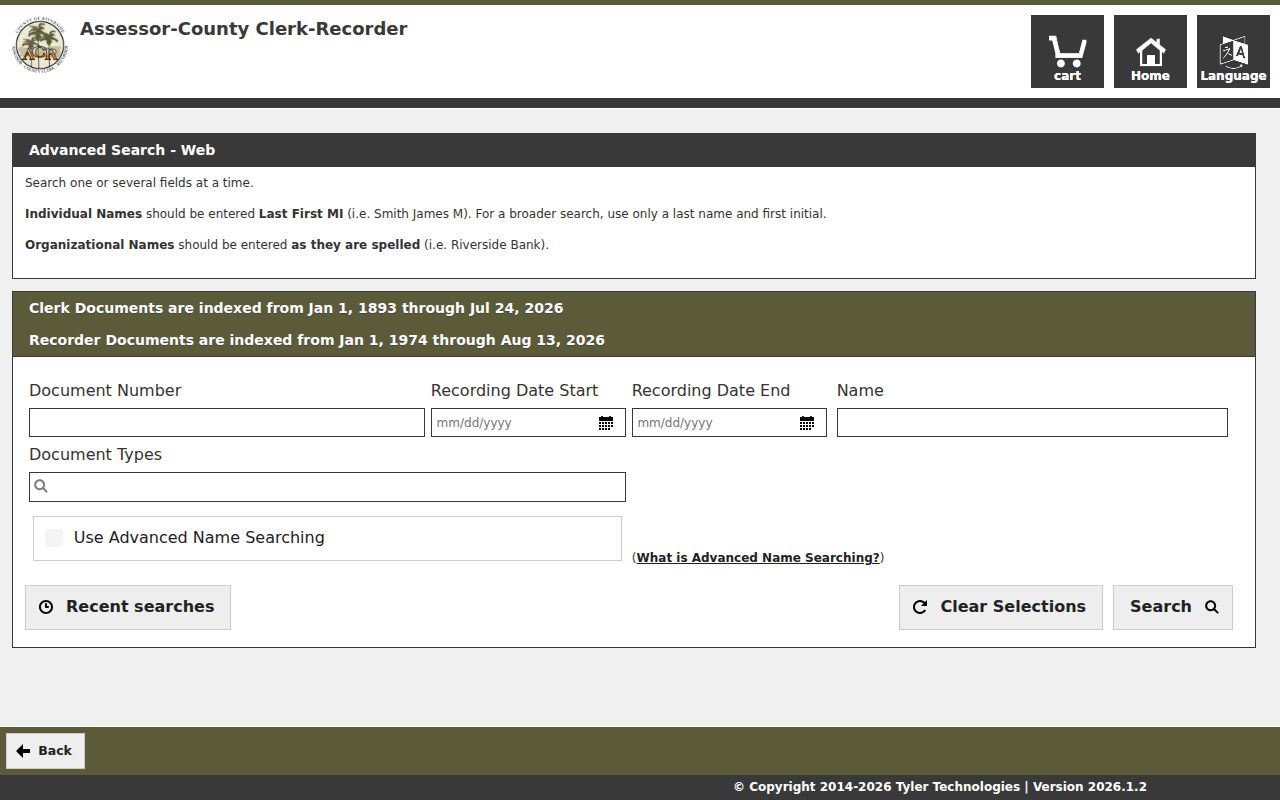
Use the recording number, party role, and legal description to bridge from the public index to a copy or an older office search.
The ACR recorder search modes show why a Palm Springs street directory must pivot from address to party or document.
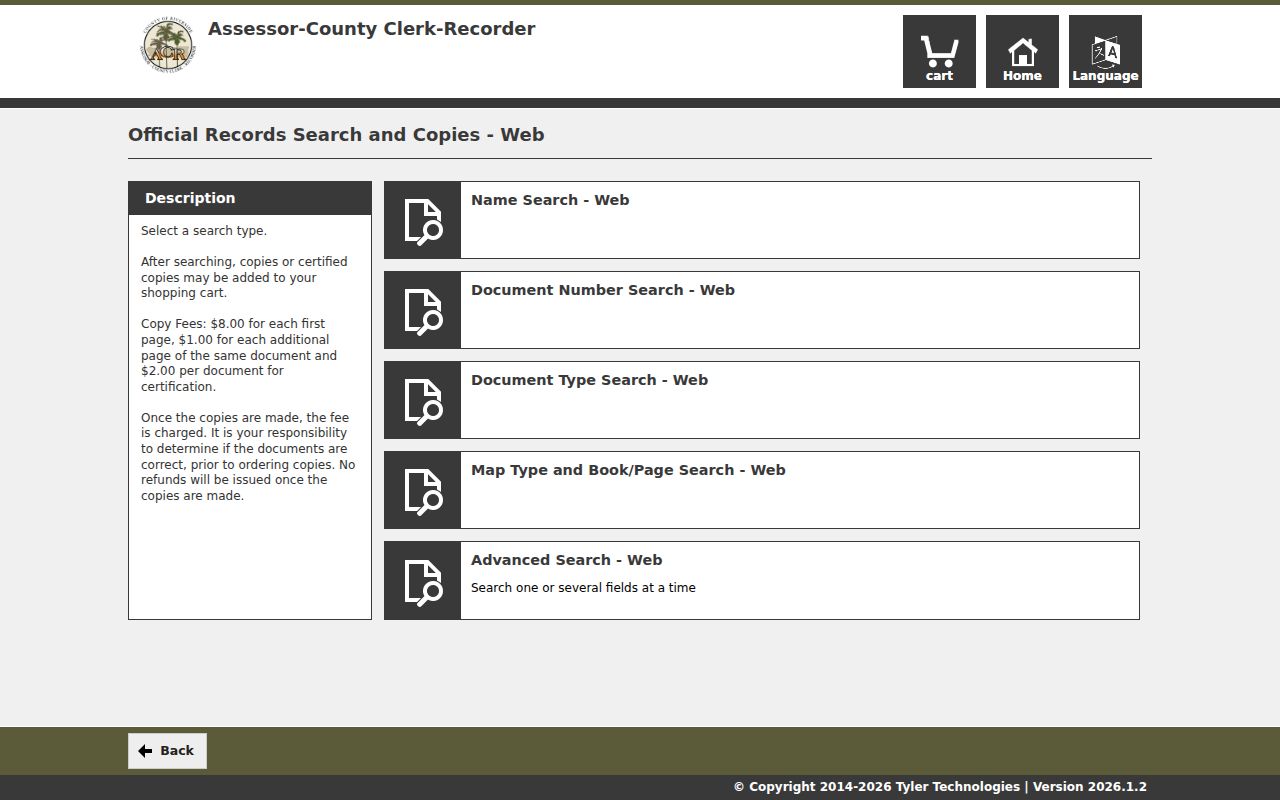
Use the recording number and legal description to bridge from the public index to a copy or an older office search.
At 1974, switch access channels instead of guessing. Gateway books and indexes, library directories, tract maps, and Sanborn maps can supply the party or date needed for an older request.
Permit History at a Palm Springs Address
Palm Springs Online groups current applications into Fire Permits, special programs, commercial and residential building, simple solar or HVAC work, engineering, planning, and business licenses. The account workflow moves from Portal Home to Apply and then to an application; existing work uses My Work, a record, Inspections, and Request Inspection. Planning stopped accepting paper applications on May 22, 2023. The public research did not expose a complete name, street-wide browse, or result inventory, so those capabilities should not be claimed.
The city’s “Researching Your Property” handout gives a better fallback chain for a house-history question: request permit history and old tract maps from the City Clerk, consult Historical Society photos and old phone books, ask the library for research help, search Desert Sun material, and compare Sanborn maps. A permit applicant may be an owner, contractor, or agent at the time of filing. It is a dated project clue, not proof that a resident lived at the address.
For records that are not exposed in the portal, a focused request through Palm Springs NextRequest should name the address or APN, date range, permit number if known, desired fields, and format. The CPRA requires a determination for an existing, nonexempt record; it does not require the city to create a new street list.
Palm Springs Street History Has Gaps
The verified Palm Springs directory span is discontinuous from 1938 through 1964. Phone directories show 1950, December 1951 through December 1956, and December 1957 through January 1961. A street section may be absent, an abbreviation may change, or a seasonal household may be recorded in one edition and missed in another. The 1964 Yellow Book’s own disclaimer makes cross-checking part of the method.
Riverside County’s 1893 creation and Palm Springs’s 1938 incorporation affect older address research. Earlier evidence may sit under predecessor San Diego or San Bernardino descriptions. The 1970 annexation added about 34 square miles of San Jacinto and Santa Rosa Mountains, so the municipal boundary is not the same thing as the urban delivery area. These history points matter when a map layer and a street source do not line up.
Write “not found in this edition,” not “did not live there.” A directory, census, newspaper, permit, and deed each establish different facts. The street directory is strongest when it names which source supports which part of the chain.
A Criss-Cross Directory Adds Household Context
Local telephone and directory entries can show a surname, given name or initial, honorific, an “r” residence mark, house number, directional street abbreviation, Palm Springs locality abbreviation, and sometimes a phone number or professional location. The 1964 volume describes a house-to-house canvass. Those marks make the old address layer valuable for family history, but the volume’s errors and omissions remain part of the evidence.
Start with the alphabetical entry, normalize initials and abbreviations, inspect adjacent editions, and use a reverse section only when that specific edition has one. Then carry the address to the assessor, deed, permit, census, and newspaper sources. The full historical shelf, including Accessing the Past, the Library of Congress phone runs, and the Historical Society Research Center, belongs on the Palm Springs city directory page rather than being collapsed into a current street list.
Criss-cross evidence can include a past household that rented or shared a structure, while the assessor may show only land ownership. That is why “who lived there” and “who owned it” must remain separate columns in a Palm Springs street directory project.
Palm Springs Street Directory Limits
No public source in the research supplies a complete list of current occupants along a Palm Springs street. Household members, many renters, utility customers, delivery recipients, and protected participants do not appear in a general street search. DMV address data is restricted by the federal Driver’s Privacy Protection Act. Confidential voter addresses and Safe at Home participants are protected. A property held by an LLC or trust can hide the human connection without making the parcel record wrong.
Lawful use. Palm Springs address records are for personal, lawful research such as family history, property questions, civic curiosity, and safe reconnection. Do not use a street directory to stalk, harass, intimidate, or harm anyone.
Keep the negative result. “Owner not displayed online,” “no street voter search,” “older recorder records at Gateway,” and “directory year not verified” are useful findings. If the question is about a specific person rather than a whole street, switch to the custodian trail that can legally answer that narrower question.